Fair Tech for the Next Billion
Democratising Digital Access through Refurbished Smartphones

The smartphone market is experiencing a quiet revolution.
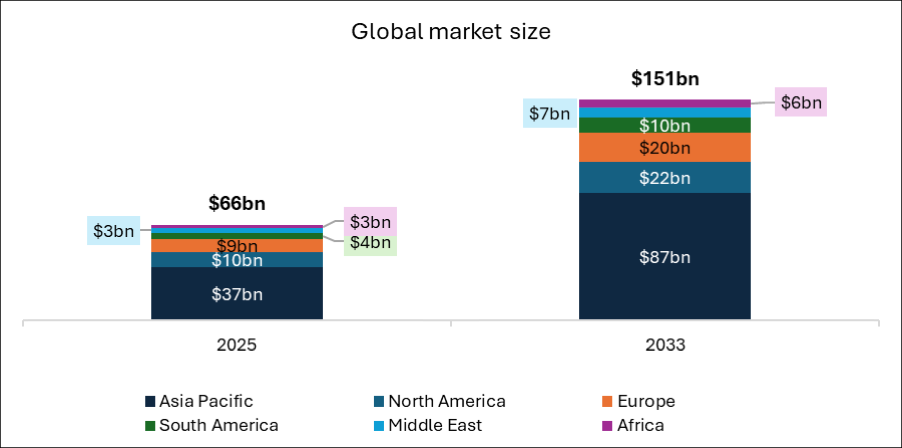
In our (inDrive) markets, a smartphone isn’t a luxury – it’s a passport to participate in the economy. But with new flagship devices like the iPhone or Samsung Galaxy now selling for more than a month’s wages, refurbished and secondhand phones are becoming an increasingly important gateway to market participation. The market is exploding, and is expected to grow from $66bn in 2025 to $151bn by 2033, an 11% annual growth rate outpacing many traditional tech sectors1.
At inDrive New Ventures, we're studying this transformation because technology access shapes the communities we serve. This evolution mirrors our core mission of making essential services accessible to everyone. Just as we've democratised transport through fair pricing, the refurbished phone market is democratising technology access.
The challenge, and the opportunity:
New smartphones are becoming more expensive at the same time as they are becoming economically vital in many emerging markets. The growth of the gig-economy sector in these markets has made smartphone ownership a precondition for economic participation.
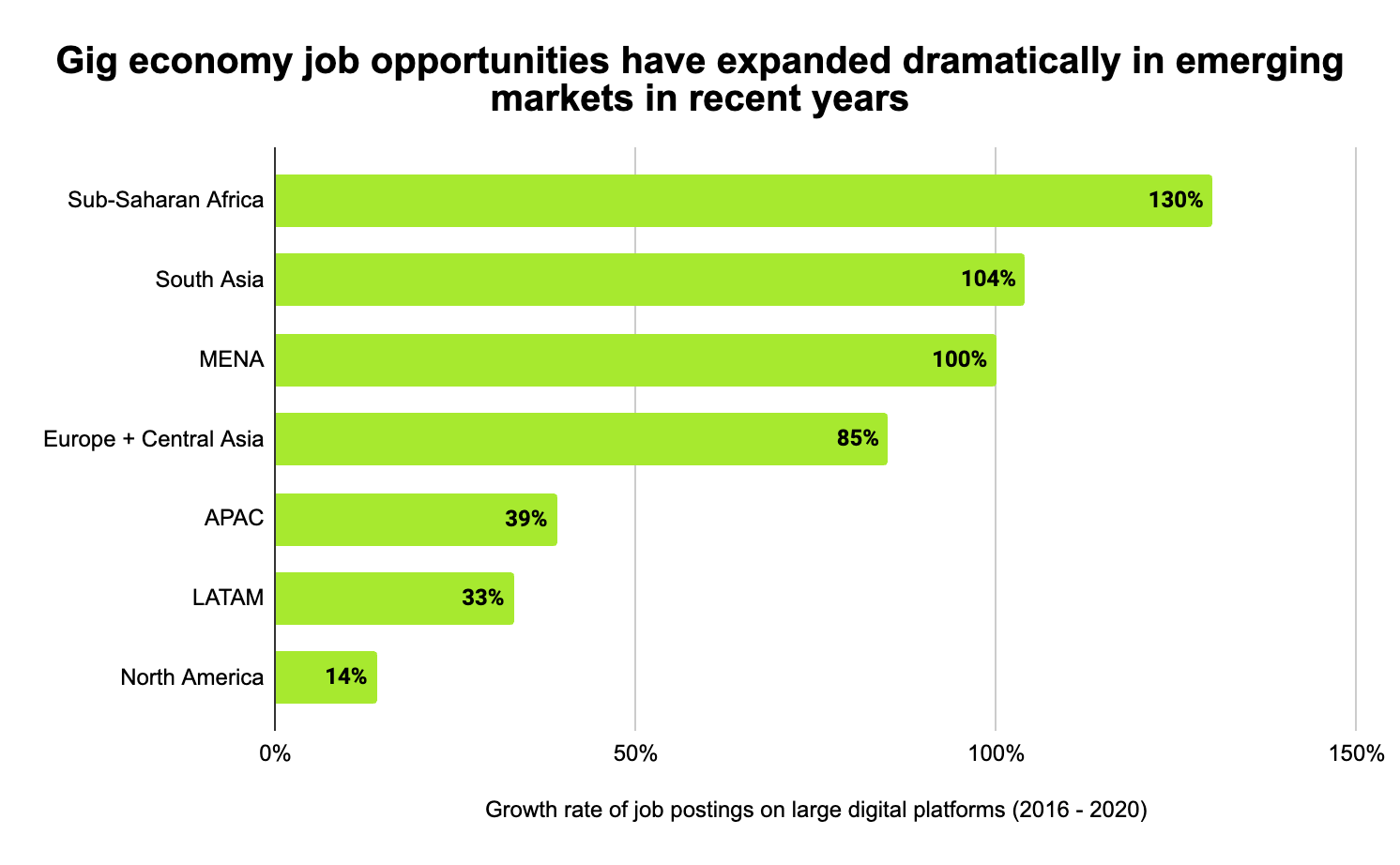
According to a 2023 World Bank report, the gig economy represents up to 12% of the global labour market. Low and middle income countries represent 40% of traffic to gig platforms, with gig job postings2 in regions such as Sub-Saharan Africa growing by 130% over the study period.
Globally, smartphone subscriptions are projected to reach 8bn by 2028, with emerging markets driving growth. Infrastructure developments now enable reliable e-commerce and logistics for device distribution, with 40-45% of refurbished phones sold online3. In mobile-first economies, smartphones serve as the primary internet gateway, making affordable access crucial for economic inclusion.
Despite their importance, new phones often remain unaffordable. A new iPhone 15 from apple sells for a minimum of $699. While that might be affordable in the US or Europe, it represents around a month’s salary in Peru4, and more than two months’ salary in Pakistan5. Refurbished, secondhand devices can be 20-50% cheaper, putting them within reach of price-sensitive consumers in developing countries.
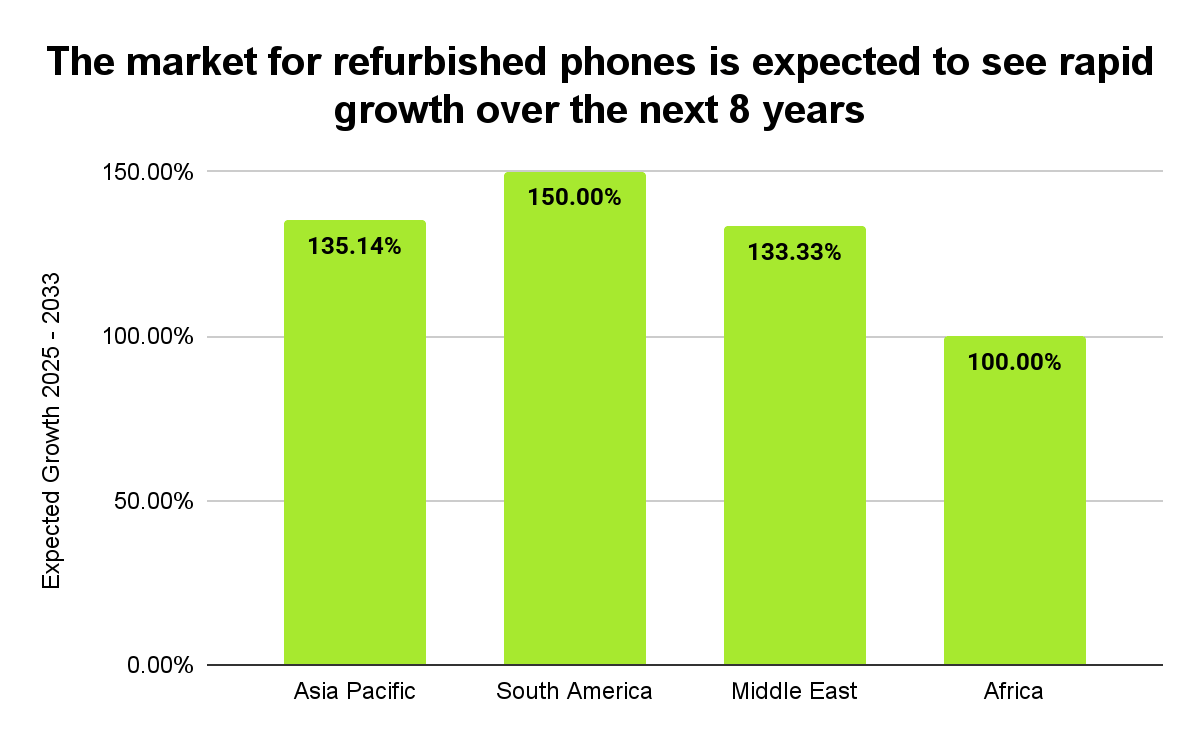
The numbers clearly suggest an opportunity. The sweet spot appears to be the $200-$500 price range, which captured over 43% of market share in 2023, offering flagship features without flagship prices. Asia-Pacific, by far the largest region globally with $37bn in sales expected this year, could grow by 135% between now and 2033, while South America is expected to see sales surge by 150% over the same period.
Persistent challenges: the trust and supply equation
Despite rapid growth, the refurbished smartphone market faces significant constraints on its potential, particularly in emerging economies where trust and reliable supply are paramount.
Customer perception has long been and remains the biggest barrier. A 2012 study by McKinsey found that 92% of surveyed consumers in Egypt and 71% in China based their purchase preference off recommendations from family and friends, versus only 29% in the UK6. Consumers in emerging markets still face weak protections and regulation, meaning that they want to test products before purchase, and find proven suppliers who they can contact if issues arise.
Market fragmentation compounds these concerns, with consumers struggling to assess device quality due to the sheer number of sellers7. The absence of international grading standards means descriptions like 'good', 'fair', or 'excellent' vary wildly between vendors, leaving buyers confused and uncertain. This creates an opening for large, trusted players to consolidate the market.
Access to a reliable supply of secondhand phones has also been a gating factor for the sector’s growth. The majority of secondhand phones are still imported from developed markets like the US and the EU, reducing the price savings for consumers in emerging markets. Winning players will need to build reliable and verifiable supply chains in their own countries to unlock these deeper cost savings.
The upshot is clear: the refurbished phone sector in emerging markets will need to understand local consumer preferences and concerns, and create a model that puts transparency and reliability front and centre.
Business model innovation: how industry players are adapting
Luckily, entrepreneurs and original equipment manufacturers are joining hands to offer these solutions.
Big global players have recognised that they can enter this market by offering to repurchase used devices, and providing quality assurance. Apple's Certified Refurbished programme now offers full warranties alongside rigorous quality testing, whilst Samsung's Certified Re-Newed initiative provides similar assurances. Beyond traditional sales, companies are experimenting with alternative ownership models — for example, Apple's iPhone Upgrade Programme effectively operates as a subscription service.
And on the ground in our key markets, we are seeing local entrepreneurs build specialised platforms to capture this disruption. Modelled on the success of players BackMarket and Gazelle in developed markets, Brazil's Trocafone has raised $48 million to build Latin America's largest refurbishment platform, and Colombia's Refurbi is gaining traction with device financing solutions. In emerging markets, UAE-based Cartlow and Malaysia's Compasia demonstrate how local platforms can thrive by understanding regional consumer needs. While consumers in emerging markets continue to prefer to establish trust through product recommendations by friends and family, online sales now account for 40-45% of the market, with platforms like Egypt's MobileMasr and Pakistan's Regen building trust through certified seller networks.
The inDrive opportunity: where platform economics meet global need
The potential is vast, but the challenges are clear. Emerging markets need platforms that understand local payment preferences, logistics challenges, and consumer behaviour.
As we examine this $150bn market transformation, the strategic alignment with inDrive's mission becomes clear. Just as we've democratised transport through fair pricing and peer-to-peer trust, the refurbished smartphone market is crying out for similar innovation, transparent pricing, quality verification, and accessible financing solutions.
Our deep understanding of emerging market dynamics positions us uniquely in this space. We've already built trust mechanisms that connect millions of users across price-sensitive markets. The same principles that power our ride-hailing platform, i.e. user ratings, transparent pricing, and local ecosystem development could address the core challenges plaguing refurbished device marketplaces: quality uncertainty, fragmented supply chains, and limited financing options.
At inDrive New Ventures, we're exploring how our platform expertise could accelerate this market's evolution. The opportunity to apply our proven emerging market experience to democratise technology access represents exactly the kind of impact-driven innovation that defines our approach to new ventures. If you're building solutions in the electronics circular economy or emerging market tech space, we'd welcome an introductory conversation.
https://www.cognitivemarketresearch.com/refurbished-and-used-mobile-phones-market-report
https://www.worldbank.org/en/news/press-release/2023/09/07/demand-for-online-gig-work-rapidly-rising-in-developing-countries
https://www.globalgrowthinsights.com/market-reports/refurbished-and-used-mobile-phones-market-106476
https://remotepeople.com/countries/peru/average-salary/#:~:text=The%20average%20salary%20in%20Peru%20is%202%2C484%20PEN%2C%20about%20$700,Salary%20Comparisons%20in%20Peru
https://remotepeople.com/countries/pakistan/average-salary/#:~:text=The%20average%20salary%20in%20Pakistan%20is%2082%2C100%20PKR%2C%20about%20$292,365%2C000%20(about%20$1301)%20monthly.
https://www.mckinsey.com/~/media/McKinsey/Featured%20Insights/Emerging%20Markets/Building%20brands%20in%20emerging%20markets/Building%20brands%20in%20emerging%20markets.pdf
https://www.globalgrowthinsights.com/market-reports/refurbished-and-used-mobile-phones-market-106476